
Introduction to Indian Board Games
Indian board games have been around for centuries, quietly shaping the way families, friends and even whole communities spent their free hours together. When you think about them, they’re not just “games” in the sense of passing time; they’re woven into the fabric of stories, rituals and even teachings. In old villages, grandparents often pulled out hand-carved wooden boards or painted cloth boards after meals, calling the kids to sit down and play. It wasn’t only about fun, it was about learning patience, strategy, counting and sometimes even moral lessons hidden inside the rules.
Many of these games travelled far beyond India’s borders. Some took on completely new names and faces — Snakes and Ladders, for example, was once called Moksha Patam and had a deep spiritual meaning about life’s ups and downs. Others, like Pachisi, inspired global classics such as Ludo. What’s interesting is that while digital games dominate today, these traditional board games are seeing a quiet comeback. People are craving a slower, more tactile way to connect, to teach their children something from their own roots, or just to experience a different kind of fun.
You’ll also notice that Indian board games aren’t uniform. Some are simple counting games played with seeds or shells, others are complex strategy contests designed for kings. Some were gender-neutral, others were traditionally taught to specific groups. This variety mirrors India’s own diversity. In exploring them, you’re not only stepping into play but into history, geography and culture at once. And if a few rules feel odd at first or boards look handmade and imperfect, that’s part of their charm — they weren’t meant to be mass-produced, they were meant to be lived with and passed down.
Traditional Indian Board Games
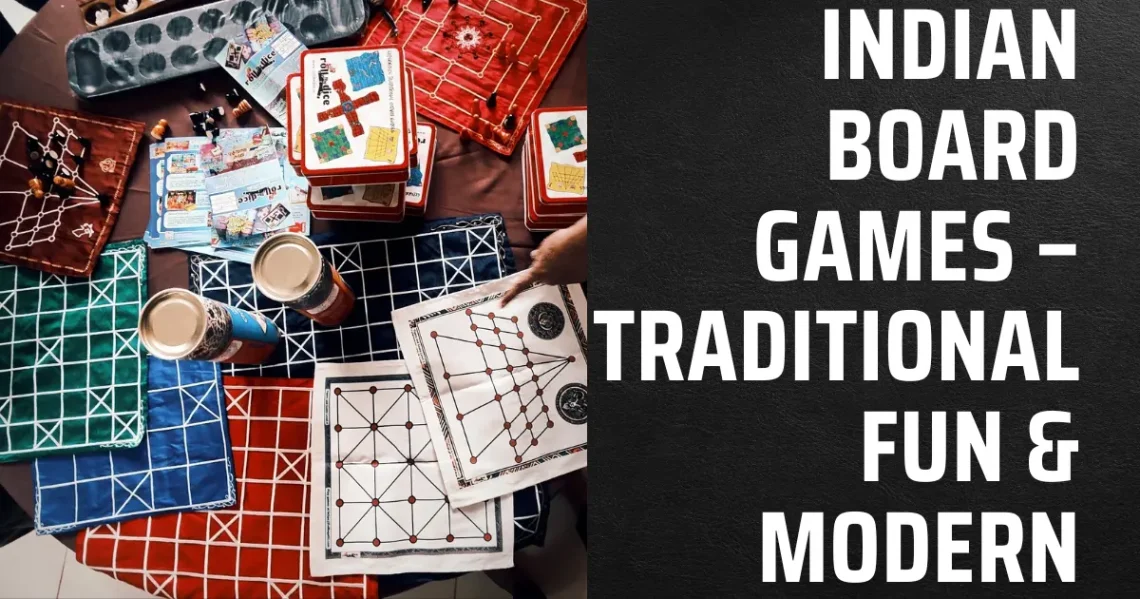
When people talk about Indian board games, the first images that pop up are usually colourful cloth boards, hand-painted dice, cowrie shells or small wooden pawns. These aren’t just props; they tell a story about how deeply games are rooted in daily life across the subcontinent. Traditional Indian board games go far beyond mere amusement. In earlier times they were a social glue, a way for neighbours to gather in courtyards after the day’s work or for children to sit with elders on verandas. The rules weren’t always written down in neat booklets. They were explained verbally, sometimes with little arguments about “who’s doing it right” — and that back-and-forth was part of the fun too.
Many of these games are surprisingly old. Archaeologists have found game boards carved into temple floors, palace steps, even rocks at ancient sites. That means a king could have been playing the same game as a farmer hundreds of kilometres away. Some, like Pachisi or Chaupar, were said to be favourites in royal courts, while simpler counting games such as Pallanguzhi or Ali Guli Mane kept children entertained and taught them maths without any textbooks. Others carried moral lessons: Moksha Patam, which later became Snakes and Ladders, was originally designed to show how virtues lift you up and vices bring you down.
The beauty of these games lies in their adaptability. A piece of cloth can become a board; tamarind seeds can stand in for counters. This flexibility helped them survive centuries of change. Even today, in a few Indian homes, you might find a faded board tucked away in a trunk or a handmade set gifted by a grandparent. Playing one feels like opening a small time capsule where stories, culture and playfulness meet.
Pachisi – The Royal Game
Pachisi is probably the most famous of all traditional Indian board games, and for good reason. The name itself comes from the Hindi word “pachis,” meaning twenty-five, which refers to the highest score a player could throw with cowrie shells, the original dice. The board is shaped like a cross, usually drawn on cloth, with each arm of the cross divided into squares. Four players sit on each arm, and their pieces travel counter-clockwise before heading into the centre. It sounds simple when you explain it like that, but once you start playing, the mix of luck and strategy can be surprisingly addictive.
Historically, Pachisi wasn’t just a pastime for ordinary folk; it had royal associations. Chronicles describe it being played in the courts of the Mughal emperors and other Indian kings. There are even stone-carved boards on the floor of the palace at Fatehpur Sikri, where Akbar supposedly played a life-size version using his courtiers as pieces. Imagine standing there, throwing shells instead of dice, while people move around as pawns — it must have felt like a blend of theatre and game.
What makes Pachisi interesting is how easily it adapts. You don’t need a fancy set; a chalk drawing and some small tokens are enough. Yet when played with a full, hand-embroidered cloth board and brightly painted pawns, it feels ceremonial, almost like a ritual. Some families still bring it out during festivals, not just to play but to pass on the memory of older times. And even if you’ve only ever played its modern cousin, Ludo, you can sense the DNA of Pachisi in it — the same race to the centre, the same mix of chance and planning. Playing it today is like shaking hands with centuries of history in a playful way.
Moksha Patam (Snakes and Ladders)
Long before it became the colourful, dice-rolling race that children know today, Snakes and Ladders was something very different in India. It was called Moksha Patam (or sometimes Paramapada Sopanam in the south), which literally means “steps to liberation.” The board was a kind of teaching tool disguised as a game. Each ladder represented a virtue like honesty, generosity or devotion, while each snake symbolised a vice such as anger, greed or pride. When you landed on a ladder, you rose toward enlightenment; when you hit a snake, you fell back into the cycle of rebirth. So, in a sense, players weren’t just racing to the top—they were symbolically navigating the moral journey of life.
The original boards were often hand-painted on cloth, with vibrant illustrations of gods, demons, saints and everyday people. Children would sit around them on the floor while a parent or teacher explained the meaning behind each square. There were usually more snakes than ladders, reflecting the old belief that virtues are hard to achieve and vices easy to fall into. That little imbalance gave the game its tension and, perhaps, its lesson.
During the colonial period the game travelled abroad, losing its spiritual layer and becoming a simpler pastime called Snakes and Ladders. Dice replaced cowrie shells, and the moral teachings faded into bright numbers and cartoons. But even stripped down, it remained compelling, which shows how strong the underlying design is.
Today some Indian families still play versions closer to the original, especially at temples or during festivals, using hand-painted cloths passed down through generations. Sitting cross-legged around such a board, you feel something deeper than a mere roll-and-move race — you get a glimpse of a tradition where play and philosophy quietly meet.
Chaupar and its Variants
If Pachisi was the polished, courtly race game of India, then Chaupar was its lively cousin — a little rougher around the edges but every bit as strategic. The board is similar, a cross-shaped cloth divided into squares, but the movement of pieces and the scoring have their own twist. Instead of cowrie shells, Chaupar traditionally used long dice made of wood or bone, rolled in a special way. This small change makes the rhythm of the game feel different from Pachisi. The name “Chaupar” itself hints at “four parts,” and that’s exactly how the board is laid out, with players sitting on each arm and sending their pawns racing toward the centre.
Chaupar’s history is laced with legend. It appears in epics like the Mahabharata, where a form of dice play triggers the famous game between the Pandavas and Kauravas — though that was more about gambling than friendly competition. Over the centuries, many regions adapted Chaupar into their own local versions. In Rajasthan you might find a board painted in bold reds and yellows; in Uttar Pradesh the rules can be slightly different. These variants kept the game alive by letting each community add a flavour of its own, rather than freezing it into a single “official” form.
Playing Chaupar today feels like stepping into that living tradition. You sit on the floor, cloth board spread out, pawns lined up like little soldiers, dice clattering in a way no plastic cube can replicate. There’s talk, teasing, maybe even small arguments over moves — all part of the charm. Some households still bring it out at weddings or after big meals during festivals, where elders teach younger ones the old rules. It’s not just a race to the centre but a gentle hand-off of memories, strategy and connection.
Ganjifa – Card-Based Board Play
Ganjifa is a fascinating outlier among Indian “board” games because it’s technically a card game, yet the way it’s played often involves spreading cards in patterns on the floor or a cloth board. In its original form, Ganjifa was a set of small, round hand-painted cards, each one a miniature work of art. They were made of layers of pressed paper, sometimes even ivory or wood for kings and nobles. Designs showed gods, court scenes, birds, floral borders — the kind of detailed painting you might see in old manuscripts. Playing wasn’t just about the rules; it was about holding something beautiful in your hands.
The game itself has roots going back to Persian courts and then took on a distinct Indian identity under the Mughals. Different regions evolved their own decks. In Odisha you still find “Dashavatara Ganjifa,” featuring the ten avatars of Vishnu. In Sawantwadi, Maharashtra, artisans paint Ganjifa cards even today, and a few families keep the tradition alive by teaching the rules alongside the craft.
Ganjifa could be played by two, three or more people, with rules that mix trick-taking, memory and chance. Because the cards are round and not standardised, you often have to learn from someone who already knows. That oral passing down adds a layer of intimacy — you’re not just reading instructions, you’re being initiated into a small cultural circle.
While the mass production of Western-style playing cards pushed Ganjifa into obscurity, it’s quietly reviving among collectors, museums and even hobby groups. Some people display the decks in frames, others still shuffle and play. Sitting down with a set feels like time slows a little: you’re looking at paintings, listening to stories and playing at once, which is something rare in modern games.
Strategy and Skill-Based Games
Not every Indian board game was about racing pieces or rolling shells. Some were built almost entirely on mental sharpness, counting, and pattern recognition. These strategy and skill-based games sat somewhere between pastime and quiet training ground for the mind. They taught you to plan ahead, to think a few moves in advance, and to keep track of numbers while chatting casually with your opponent. That mix of mental focus and social play is one of the reasons they survived for centuries.
Across the subcontinent you can still find traces of these games carved into temple floors or community halls. They were played with pebbles, seeds, shells or small beads moved across rows of pits, holes or squares. In the south, children and elders alike play Pallanguzhi or Ali Guli Mane, a counting game where each move shifts handfuls of seeds. In some northern regions, games like Navkankari (a version of Nine Men’s Morris) became a test of patience and foresight rather than speed. You win not by lucky rolls but by outthinking and outmanoeuvring your opponent.
Because the boards were often part of everyday objects — a stone slab outside the house, a carved wooden tray, even a chalk drawing — these games fitted easily into daily life. You could pause between chores, make a few moves, and then continue later. That stop-and-start rhythm matched the slower pace of life. Even today, if you sit down with one of these games, you’ll notice conversations wander, children learn to count without realising it, and everyone relaxes a little.
In a world that’s mostly digital and fast, there’s something refreshing about a game where you touch real seeds, watch piles grow or shrink, and rely on your own mental map instead of a screen. It’s both a gentle lesson in focus and a small cultural bridge to older times.
Pallanguzhi / Ali Guli Mane
Pallanguzhi — known as Ali Guli Mane in Karnataka and by other names elsewhere — is one of those deceptively simple seed-counting games that can keep two players absorbed for hours. The board is usually a long, narrow piece of wood with two rows of small, scooped-out pits. Into these pits go cowrie shells, tamarind seeds, beads, or whatever is at hand. Each player controls one row, and on their turn, they scoop up all the pieces from a pit and drop them one by one into the next pits in a looping rhythm. The goal is to capture as many seeds as possible, but it’s not just luck: you’re constantly counting, planning where your last seed will land, and trying to anticipate your opponent’s next move.
In southern India, you still see this game in many homes, especially during festivals. Grandmothers teach grandchildren not only the rules but also little rhymes or stories while playing, making the learning part of the fun. There’s no rush; rounds can be played slowly, with plenty of conversation in between. That calm, almost meditative quality is part of the game’s charm. In villages, people might sit on a veranda, the wooden board between them, seeds clicking softly like a small drum beat.
Although its origins are ancient — related to the wider family of mancala games found in Africa and Asia — Pallanguzhi holds its own unique place in Indian culture. The boards are often carved beautifully, sometimes passed down for generations as family heirlooms. Children who play it pick up arithmetic skills without realising; adults use it to relax, sharpen their minds, and connect with a tradition older than memory. Sitting down to a game today feels like bridging a gap between everyday life and something timeless.
Navkankari (Nine Men’s Morris)
Navkankari, often called Nine Men’s Morris in English, is one of those games that looks simple at first glance but reveals layers of strategy the more you play. Its roots in India go back a long way, although similar boards have been found across Europe and Africa too, which shows how far ideas travelled. The board is usually a set of three concentric squares connected by lines, with small points at the intersections. Each player has nine pieces (or “men”), and the aim is to form “mills” — three in a row — which then lets you remove one of your opponent’s pieces. The game starts by placing your men one by one, then moves into sliding them along the lines, and eventually becomes a tense dance of blocking and creating mills at the same time.
In India, Navkankari has been carved into temple stones, palace courtyards and even roadside platforms, a silent reminder of how much people once played outdoors. You can imagine two travellers waiting for a caravan, whiling away time with stones on a carved grid. Unlike race games, this one rewards patience, planning and the ability to mislead your opponent. There’s no dice or shells; the outcome sits squarely on your choices.
Playing Navkankari today feels oddly modern. It’s abstract, symmetrical and quick to learn but hard to master — qualities that make it as gripping as any contemporary strategy game. Some elders still teach it to children, drawing the board with chalk and using bottle caps or pebbles as pieces. The back-and-forth of making mills, losing them and re-forming them creates a rhythm that’s almost like a quiet duel. In a world of flashy screens, sitting on the floor moving small counters along neat lines can be a surprisingly refreshing way to connect and think.
Modern Adaptations of Indian Board Games
One of the most interesting things happening right now is how old Indian board games are quietly stepping into the modern world. For a long time many of them were tucked away in trunks or only played during festivals. But in the last decade or so, designers, hobbyists and even small family-run businesses have started reimagining them for today’s homes. You can now find slick, boxed versions of Pachisi, Chaupar or Pallanguzhi with polished wooden pieces, clear printed rules and colourful artwork. Some are marketed as “heritage games” to gift at weddings or festivals; others are designed with bold graphics to appeal to younger players who may have never seen the original cloth or seed versions.
The adaptation isn’t just about looks. Some people are tweaking the rules slightly to make games shorter or easier for children to learn. There are mobile apps and online versions too, letting families play Moksha Patam or Navkankari on a screen when they’re far apart. Purists might grumble that the tactile feel of seeds and hand-drawn boards is lost, but these digital and board revivals are also how the games survive. Without them, many younger people might never know these games existed at all.
What’s touching is that a lot of these projects come from a place of love rather than just business. You’ll see small artisans painting Ganjifa cards or creating travel-size wooden boards, then sharing stories of how their grandparents taught them. In classrooms some teachers use these games to explain maths or ethics, blending tradition with education. It’s not a perfect transition — sometimes a game feels “too modern” — but it’s still a bridge. These adaptations show that a game born centuries ago can still find a place in living rooms today, connecting generations in a new way.
Conclusion
Exploring Indian board games is a bit like opening an old wooden chest and finding not only toys but memories, stories and lessons tucked inside. These games are not just relics of a slower time; they’re living pieces of culture that still have something to offer. Whether it’s the quiet counting of seeds in Pallanguzhi, the moral ladders and snakes of Moksha Patam, or the tactical battles of Navkankari, each game reflects a slice of everyday life, values and imagination.
In today’s fast, screen-filled world, bringing out a hand-painted board or even a modern adaptation can create a small island of focus and connection. Children learn to count without noticing, adults remember stories their grandparents told them, and everyone gets to experience a rhythm of play that’s older than most of the things around us. Some boards may be faded, some rules forgotten or argued over, but that imperfection is part of their charm.
Keeping these games alive — whether by playing them, gifting them, or even collecting them — isn’t just nostalgia. It’s a way of keeping a cultural thread intact, passing on a gentle form of learning and togetherness to the next generation. It reminds us that fun, skill, patience and tradition can coexist on a simple board spread out on the floor.
FAQs on Indian Board Games
Q1: Are Indian board games only for children?
Not at all. Most of them were played by adults and children alike. Some, like Pachisi or Navkankari, are highly strategic and can be enjoyed at any age.
Q2: Do I need special equipment to play them?
Often no. Many games can be played with a cloth board, chalk drawing or even on a carved stone. Seeds, shells or coins work as counters.
Q3: Where can I buy or learn these games today?
Heritage stores, online marketplaces, craft fairs and even some museums sell or teach them. There are also mobile apps recreating classics like Snakes and Ladders or Pallanguzhi.
Q4: Why should we play traditional games when we have modern ones?
They’re not just entertainment. They help teach counting, patience and strategy, and they connect you to a cultural story much bigger than the game itself.
Q5: Are there regional variations of the same game?
Yes. Names, rules and designs often shift from one region to another. That variety kept the games alive and is part of what makes exploring them fun.